
The eyes, ears, and voice of the forest…
Articles
Protect our Sierra Nevada forests.
Sequoia ForestKeeper participates in legal actions to preserve and protect our Sierra Nevada forests.
Here are PDF documents regarding:
Legal Actions
Comments about Legal Actions
Field Work by Sequoia ForestKeeper
Scientific articles published by our team
Scientific Articles
2024
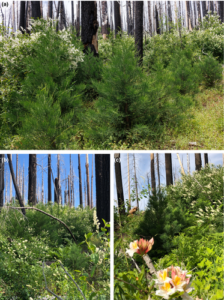
Postfire reproduction of a serotinous conifer, the giant sequoia, in the Nelder Grove, California
The giant sequoia, a serotinous conifer naturally occurring in mixed-conifer forests of the southern and central Sierra Nevada, California, USA, is the world's largest tree species. Giant sequoia reproduction has been severely lacking over the past century, due to fire exclusion, creating a significant conservation threat. Previous research on postfire sequoia reproduction in high-severity fire areas, relative to low- and moderate-severity areas, is limited.
At 6 years postfire, we investigated giant sequoia reproduction in a high-severity fire area, and nearby low-/mixed-severity fire areas, in the Nelder Grove, which burned in 2017 in the Railroad fire. Postfire giant sequoia reproduction was positively correlated with fire severity in terms of density, height (growth), and proportion (relative to other conifer species), and sequoia seedling/sapling density was positively correlated with percent shrub cover.
There was no correlation between distance to live sequoia seed source and density of sequoia reproduction. More research is needed in other mixed-severity fire areas, with larger high-severity fire patches, to determine whether a similar postfire response occurs elsewhere.

Reproduction of a Serotinous Conifer, the Giant Sequoia, in a Large High-Severity Fire Area
Giant sequoia groves, located on the western slope of the central and southern Sierra Nevada mountains in California, USA, have been experiencing regeneration failure for more than a century due to the exclusion of wildfires. Giant sequoias are serotinous conifers and have evolved a strong relationship between high-severity fire and reproduction.
While this relationship is widely recognized, only one previous peer-reviewed study has directly investigated giant sequoia reproduction and fire severity, and that study used different fires for each severity class. We conducted a study of giant sequoia reproduction and fire severity in a single fire, the KNP Complex fire of 2021, within the Redwood Mountain Grove in Sequoia and Kings Canyon National Park.
We found that giant sequoia seedlings are more dominant relative to other conifer species and are growing faster in a large high-severity fire area than in adjacent low/moderate-severity areas. Distance to the nearest live sequoia seed source was not a significant factor in sequoia seedling density. Our results call into question the basis for widespread plans and projects designed to prevent high-severity fires and should reevaluate moving forward with proposed tree planting activities in high-severity fire areas within giant sequoia groves.
Donate
Sequoia ForestKeeper is a 501c(3) non-profit membership organization.
We depend on the support of individuals, businesses, and organizations.
Membership funds go directly to sustain the valuable work of Sequoia ForestKeeper.

Quick Links
Follow Us
© 2026 Sequoia ForestKeeper All Rights Reserved.
Web Design and Maintenance by Kahl Consultants.